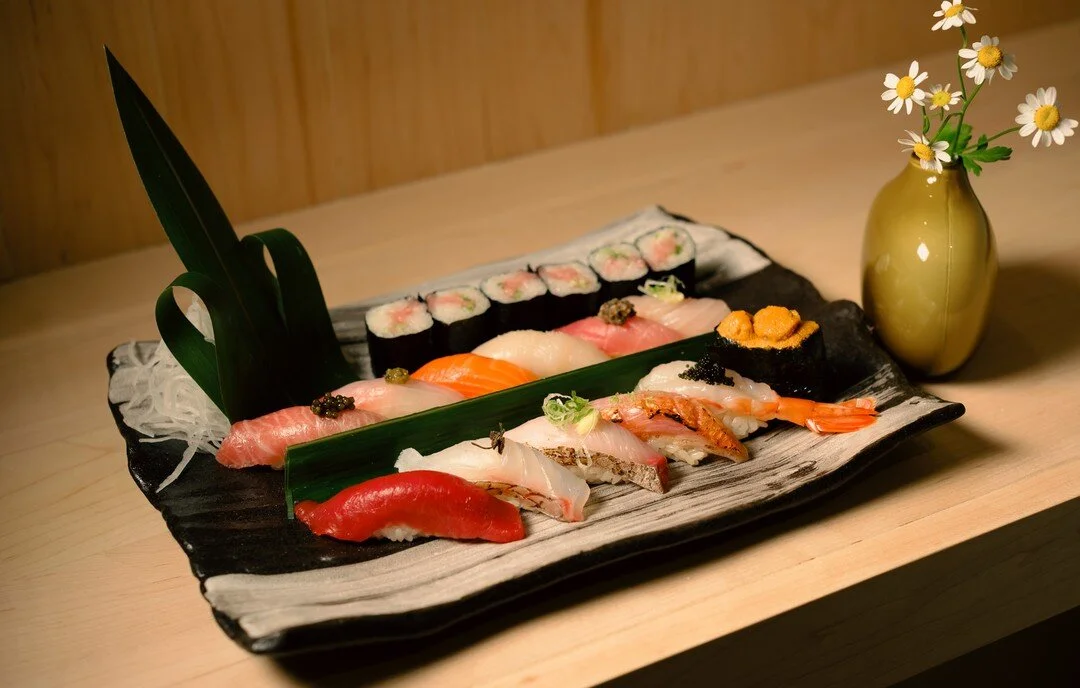
Most people assume that the freshest fish makes the best sushi. It’s an intuitive assumption — and there are styles of Japanese cooking, like arai or ikizukuri, that genuinely prize the springy, just-killed texture of pre-rigor fish. But Japanese sushi has long worked with a quieter, parallel idea: for many species, controlled aging unlocks deeper, more complex flavors than the freshest fish can offer.
At Atto Sushi, aging is a discipline. Our chef ages select fish by a process Japanese chefs call nekaseru (寝かせる, “to let rest”); the resulting style is called jukusei (熟成) sushi. Here’s what the food science says about why aging works — and how we apply it to the sushi on your plate.
The Biochemistry: ATP, IMP, and Beyond
The story begins with adenosine triphosphate (ATP) — the energy molecule that powers living muscle. The moment a fish is killed, ATP starts breaking down through a sequence that’s been mapped by fishery scientists since the 1950s:
- ATP → ADP → AMP → IMP (inosinate) → HxR (inosine) → Hx (hypoxanthine)
The middle of that chain — IMP, inosine 5′-monophosphate — is one of the foundational umami compounds in food. It was first isolated from katsuobushi (dried bonito) by Kodama in 1913, and it’s the same molecule responsible for the savory depth of dashi. As IMP accumulates, the fish develops a deep, savory taste it didn’t have when fresh.
The classical food-science finding here is umami synergy. Yamaguchi (1967) showed that mixing IMP with glutamate (the other major umami compound) doesn’t simply add the two tastes — the perceived umami can be roughly seven to eight times more intense than either compound alone at the same total concentration. This is why aged fish on seasoned sushi rice tastes so much fuller than the sum of its parts: the IMP from the aged fish meets the glutamate-rich rice and the synergy multiplies.
An important detail that’s often skipped: IMP doesn’t accumulate forever. Across most species studied, IMP rises sharply in the first 24–72 hours after death and then slowly declines as the same enzymes convert it to inosine (HxR) and hypoxanthine (Hx). Hx contributes bitterness and is associated with spoilage. Fishery scientists summarize this whole dynamic in a single number called the K-value — the proportion of HxR + Hx in the total nucleotide pool — and use it as an objective freshness index.
So what is a chef actually waiting for during a multi-day aging? Past the first few days, the dominant change isn’t IMP — it’s proteolysis by the fish’s own enzymes, releasing free amino acids. We’ll come back to that in a moment.
Protein Breakdown, Texture, and Glutamate
Right after death, fish enters rigor mortis: muscle proteins lock together and the flesh stiffens. Onset and duration depend on species, temperature, and how the fish was killed (well-done ikejime can extend the rigor window). Some Japanese preparations, like arai, are built around this firm pre- or in-rigor texture; aged sushi is built around what comes after.
As rigor resolves, the fish’s own enzymes — especially cathepsins (B, D, L, H) and calpains, plus collagenases acting on connective tissue — break muscle proteins down into peptides and free amino acids. Two things happen at once:
- Texture softens from rigid to supple as collagen and myofibrils degrade, producing the silky, yielding quality of properly aged neta.
- Glutamate accumulates in the free amino acid pool, fueling the IMP×glutamate synergy described above. Glutamate, alanine, and other amino acids also contribute their own taste — alanine is mildly sweet, glycine adds another layer of sweetness, and together they shape the “layered” flavor that aged fish carries.
Push it further than that and proteolysis becomes early decomposition: texture turns mushy, microbial activity gains ground, and the fish is past its window. The art of aging is finding the moment before that point.
The Dry-Aging Process at Atto Sushi
Our approach pairs traditional Edomae principles with precise modern controls:
- Temperature control: Fish is aged in dedicated refrigeration held at narrow temperature ranges. Small temperature drifts change enzyme activity disproportionately, so stability matters more than the exact set point.
- Daily monitoring: Our chef inspects every piece of aging fish daily — touch, aroma, color, the way the flesh yields. No timer replaces this judgment.
- Individual treatment: Two fish of the same species from the same catch can reach peak on different days. Each is aged on its own clock.
- Selective aging: Not all fish should be aged. Some shellfish and very lean fish are best served close to fresh. Knowing what benefits from aging — and what doesn’t — is part of the craft.
How Different Fish Respond at Our Counter
The species-specific timelines below reflect our chef’s practice at the Atto Sushi counter. They are working windows, not laboratory measurements: each piece is taken to the point our chef judges to be peak, which can fall earlier or later depending on the fish.
White Fish
Hirame (fluke), tai (sea bream), and kinmedai (golden eye snapper) tend to gain a subtle sweetness and a refined umami over a few days, while the texture becomes silky without losing structure. Kinmedai in particular shifts dramatically: a relatively mild flavor when fresh, complex and rich after several days at our counter.
Tuna
Maguro, chutoro, and otoro are among the most rewarding fish to age. The deep red flesh develops layered savory depth over a week or more — the fat in otoro becomes more luscious, the lean maguro gains a near-beefy intensity. Our chef ages each tuna individually to its own peak.
Traditional Edomae Species
Aji (horse mackerel), kohada (gizzard shad), and other classic Edomae fish are typically taken on a shorter timeline — sometimes just one or two days — reflecting the curing-and-marinating heritage of Edo-period sushi rather than long whole-fish aging.
The Edomae Lineage
Aging fish for flavor isn’t a recent invention. In the Edo period (1603–1868), sushi chefs in what is now Tokyo developed techniques to extend the life of their catch — vinegar curing (shimesaba for mackerel), salt curing, soy-marinating (zuke), simmering in sweetened soy reduction (nitsume, used for anago), and kelp-curing (kobujime, wrapping white fish in kombu to draw out moisture and infuse glutamate). Each was a form of controlled aging using salt, acid, or umami-rich media to develop flavor while protecting the fish.
Modern temperature- and humidity-controlled dry-aging of whole fish is a more recent extension of those principles, made possible by reliable refrigeration. The lineage is real, but the precision is new: time and intention applied with tools the Edo masters didn’t have.
The Difference You Can Taste
Aged fish has layers. The initial flavor gives way to a deeper savory note, then a lingering umami finish that stays on the palate. The texture is more supple, almost melting. That’s the product of IMP, glutamate and other free amino acids, and the careful breakdown of muscle proteins — the invisible work behind every piece at our counter.
“Every piece of fish has its perfect moment — the point where aging has developed maximum umami while the texture remains pristine. Finding that moment is what we do.”
At Atto Sushi, this is what we mean by dry-aged omakase. It’s not just about what fish we serve — it’s about when we serve it.
A Note on Food Safety
Dry-aging fish for raw service requires professional sourcing, strict refrigeration, daily inspection, sanitation controls, and parasite-control practices where required. This article explains flavor development, not a home-aging method.
Sources & Further Reading
- Yamaguchi, S. (1967). The synergistic taste effect of monosodium glutamate and disodium 5′-inosinate. Journal of Food Science, 32(4), 473–478.
- Yamaguchi, S., & Ninomiya, K. (2000). Umami and food palatability. Journal of Nutrition, 130(4S), 921S–926S.
- Saito, T., Arai, K., & Matsuyoshi, M. (1959). A new method for estimating the freshness of fish. Bulletin of the Japanese Society of Scientific Fisheries, 24, 749–750. (Original K-value paper.)
- Huss, H. H. (1995). Quality and Quality Changes in Fresh Fish. FAO Fisheries Technical Paper 348.
- Howgate, P. (2006). A review of the kinetics of degradation of inosine monophosphate in some species of fish during chilled storage. International Journal of Food Science & Technology, 41(4), 341–353.
- Hong, H., Regenstein, J. M., & Luo, Y. (2017). The importance of ATP-related compounds for the freshness and flavor of post-mortem fish and shellfish muscle. Critical Reviews in Food Science and Nutrition, 57(9), 1787–1798.
- Cheret, R., Delbarre-Ladrat, C., de Lamballerie-Anton, M., & Verrez-Bagnis, V. (2007). Calpain and cathepsin activities in post mortem fish and meat muscles. Food Chemistry, 101(4), 1474–1479.
- McGee, H. (2004). On Food and Cooking: The Science and Lore of the Kitchen (rev. ed.). Scribner. (Chapter on fish biochemistry.)
Experience dry-aged omakase at Atto Sushi. Reserve on Resy or view our full menu.